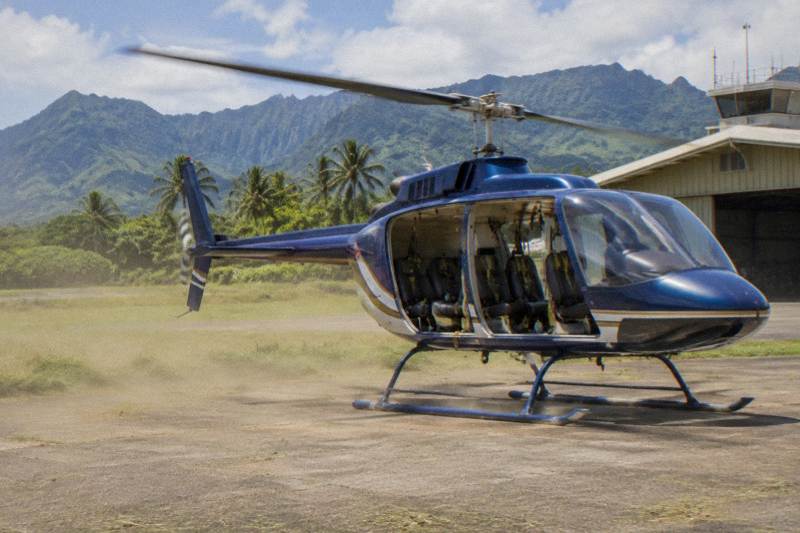
Photographing Kauai From A Helicopter: Seats, Doors And Gear
Kauai from the air is one of the most photographed landscapes in Hawaii, and the flight you book decides more about your pictures than the camera you carry. This guide compares the doors-off and doors-on options on the island, explains how seats are actually assigned, and lists the gear rules each operator prints on its own listing.
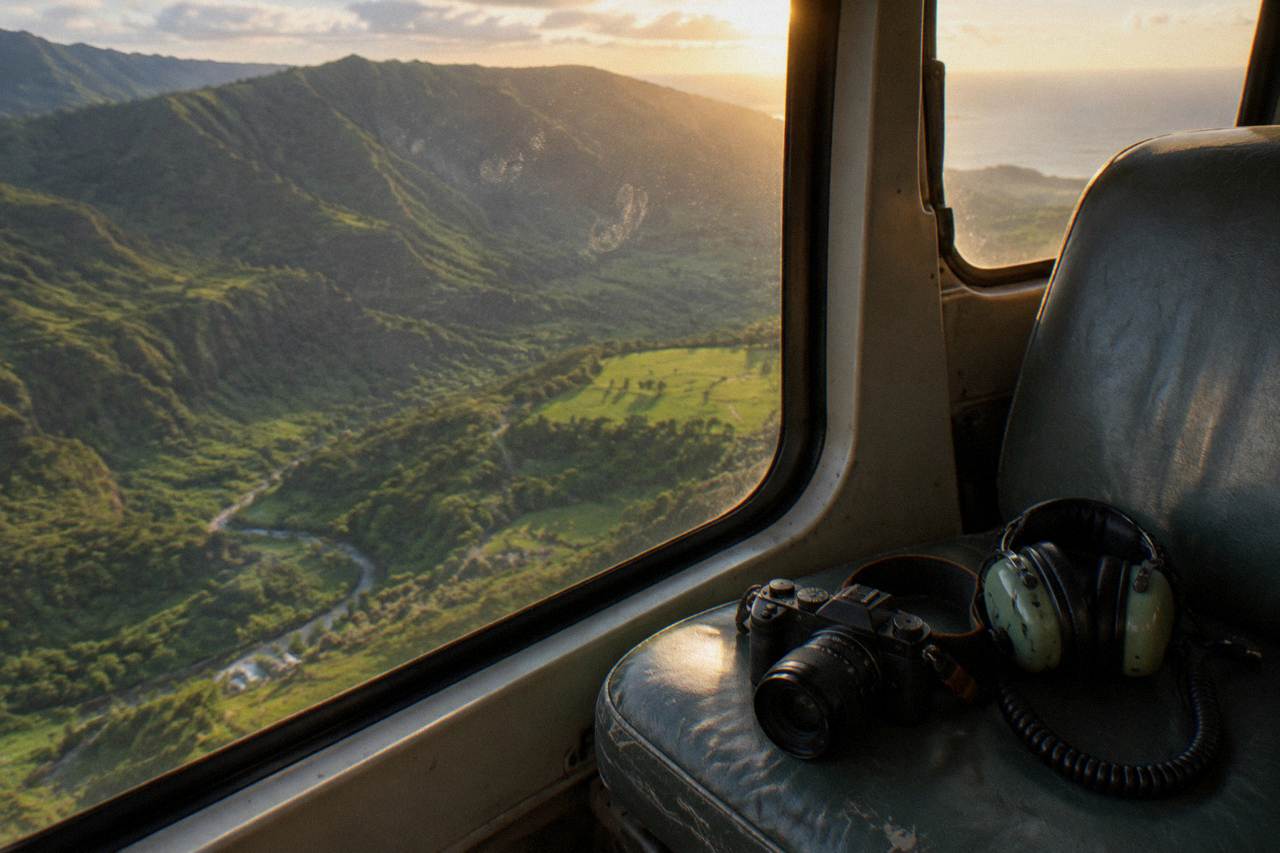
Short answer
For photography, the doors-off flights remove window glare entirely: the Air Kauai doors-off flight runs from $402 per person and allows only a lanyarded phone on board. For telephoto work, a doors-on flight such as the Blue Hawaiian 50-minute eco flight, from $489 per person, lets you bring a camera bag. Private flights like the Mauna Loa all-window-seat option guarantee every passenger a window.
Waimea Canyon runs about 14 miles and reaches depths of up to 3,600 feet, the Na Pali Coast stretches 16 miles with cliffs that rise as much as 4,000 feet above the sea, and Mount Waialeale's summit sits at 5,148 feet in one of the wettest spots on earth. No single ground viewpoint takes in more than a slice of that. A helicopter puts the whole island in one frame.
But the flight you choose shapes the pictures more than the camera does. A doors-on cabin gives you plexiglass between the lens and the landscape, and that plexiglass adds glare, reflections and scratches to every shot. A doors-off cabin removes all of it, then removes most of your gear with it, because the listing for the Air Kauai doors-off flight allows only a lanyarded phone on board. Seat assignment is a third variable photographers often miss: on shared flights the operator assigns seats by weight and balance, not by preference, so the window you assumed is not guaranteed until weigh-in.
This guide walks through those three decisions in order, one at a time, so you can weigh each choice before you book. It draws on the flights compared across Helicopter Tours Kauai, and it links to the deeper guides on seats, doors-off flights and weight limits where those topics get their own pages.
Doors-Off Or Doors-On: Which Is Better For Photos?
For pure image quality, doors-off wins, and it is not close: no glass means no glare, no reflections of your own arms and legs, and no color cast on the frame. The trade is gear, because the Air Kauai doors-off listing allows only a lanyarded phone, while doors-on flights let you work with a full camera. Photographers who want long lenses accept the glass; photographers who want clean frames take the open air.
The glare problem is real enough that guests describe it in their own reviews. On the Safari doors-on flight, one guest wrote: "Amazing views of the island! Not as scary as I thought it would be. Enjoyed the pilot's narration of the scenery. And front desk staff were great. Helicopter sat 2 in front and 4 in the rear. There was some glare at times off our arms and legs - wearing darker clothing helps reduce this." That is the doors-on experience in one paragraph: the view is spectacular, the glass cooperates sometimes, and dark clothing is a genuine workaround because the window reflects whatever it faces inside the cabin.
Doors-off removes the problem at the source. The Air Kauai doors-off flight, about 50 minutes in a shared cabin of six, flies with the doors removed, supplies goggles for the wind, and states on its listing that only a lanyarded phone may come on board. That rule is a photography decision as much as a safety one: loose objects and open doors do not mix, and the FAA's Hawaii air tour rules in 14 CFR Part 136 Subpart D set the operating framework these flights work under, including the 1,500-foot minimum altitude for air tours and the flotation and briefing requirements for over-water segments.
The middle path is a small-group doors-off flight with fewer strangers in the cabin. The Jack Harter MD500 doors-off flight takes at most four passengers, and one guest review describes the result: "Arthur was our pilot and he narrated the whole ride very well. We went in and out of canyons, gorges, seashores and mountains. What a breath taking view! This ride was the best activity I've done. You can see the whole island in an hour. I was just in awe!" A four-person cabin means more shoulder room to aim a phone out of the open frame.
| Factor | Doors-Off Flights | Doors-On Flights |
|---|---|---|
| Window glare | None, no glass in the frame | Present, dark clothing helps per guest reports |
| Gear allowed | Lanyarded phone only on the Air Kauai listing | Camera bags and larger gear, per operator policies |
| Wind | Strong, goggles supplied | None in the cabin |
| Minimum age | 10 on Air Kauai and Jack Harter listings | Not stated on most doors-on listings |
| Flight examples | Air Kauai doors-off, Jack Harter MD500 | Blue Hawaiian eco flight, Safari flights, Air Kauai Ohana |
The full doors-off comparison, including the harness and clothing details, lives in the doors-off flights guide.
Which Kauai Flights Give Every Passenger A Window Seat?
On shared flights, nobody is guaranteed a window, because operators assign seats by weight and balance for each flight. Two listings solve this outright: the Mauna Loa private doors-off flight seats every passenger at a window, and the Ali'i private doors-off flight sells the whole cabin to your group with nobody in a middle seat. Both cost more per person than a shared seat, but for a photographer a guaranteed window is the difference between shooting and watching.
The Mauna Loa flight is the clearest case on the roster. The listing, a private doors-off flight of about 55 minutes from the Mauna Loa heliport on Ahukini Road in Lihue, states that all passengers get window seats, passing Manawaiopuna Falls, Waimea Canyon, Na Pali and Waialeale. It carries a 4.8 rating from 522 reviews, runs from $384 per person, and lists a maximum of 275 pounds per person with 620 pounds total for the cabin. One guest review reads: "This was an awesome experience. Totally worth it and checked another bucket list item. Thanks so much for a great time. You made our 40th anniversary trip sooo memorable."
The Ali'i private flight takes a different route to the same result. It is a private doors-off flight of 1 hour 15 minutes from the Lihue Airport commuter terminal, minimum two paying passengers, from $425 per person, with a 5.0 rating from 1,794 reviews. The listing's own summary says there are no strangers in the cabin and nobody stuck in the middle seat, which is the operator's way of stating the photography benefit: you control where everyone sits, and you can rotate the best shooting position through your own group.
Shared flights are not hopeless, just unguaranteed. A guest review of the Jack Harter MD500 flight notes: "There was also only 4 people apart form the pilot so everyone got great views." Small cabins raise the odds. The seat mechanics, including why weigh-in happens at check-in and how the operators balance the aircraft, are covered in detail in the seat assignment guide, and the weight thresholds that trigger an extra seat purchase are listed per operator in the weight limits guide.
For photographers weighing the three formats against each other, the trio above covers the useful spread: the Air Kauai doors-off flight for open-frame phone work, the Mauna Loa all-window-seat private flight for a guaranteed angle, and the Blue Hawaiian doors-on eco flight for a longer camera-friendly ride.
How Does Seat Assignment Work On A Kauai Helicopter?
Seats are assigned by weight and balance, not by request, and the weighing happens at check-in before the flight. The operators state this plainly: Safari's FAQ says passengers are weighed at check-in, and every listing on this roster carries a weight policy that can require an extra adjacent seat. A photographer cannot book a specific seat, so the reliable strategies are a private cabin or a small four-passenger doors-off flight.
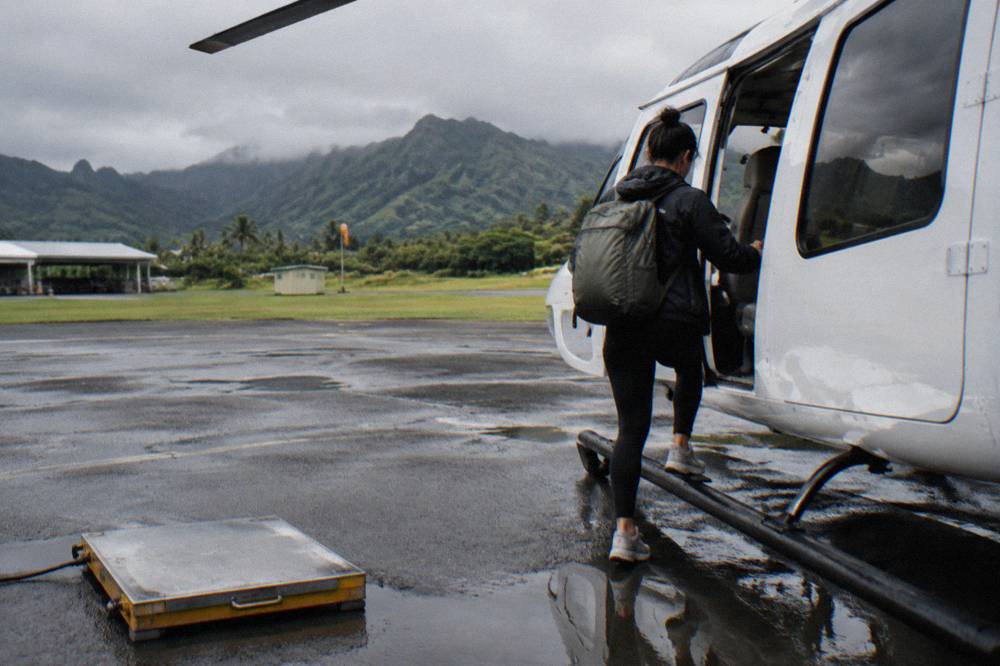
The FAA performance-plan requirement sits behind all of this. Under 14 CFR 136.75(b), the operator must complete a performance plan covering weight, center of gravity and hover limits before each rotorcraft air tour flight, which is why check-in includes a scale and why seat requests yield to the load sheet. This is not a Kauai quirk, it is the federal rule for Hawaii air tours, and it applies to every flight on this roster.
The per-operator thresholds differ enough to matter when you pick a flight. The Air Kauai doors-off listing requires an extra seat for a single passenger over 230 pounds, a pair over 400 pounds combined, or a group of three or more averaging over 190 pounds. Jack Harter's listings set the comfort-seat threshold at 250 pounds individually or 400 pounds per pair. Safari's FAQ states that 250 pounds or more may need an extra comfort seat, with 420 pounds combined for two people. Blue Hawaiian's eco flight requires an extra adjacent seat for each guest over 240 pounds. The private flights cap instead: Mauna Loa at 275 pounds per person and 620 total, Ali'i at a maximum of 275 pounds per passenger, weighed at check-in.
| Operator Or Listing | Weight Policy As Printed | Weighed At Check-In |
|---|---|---|
| Air Kauai doors-off | Extra seat over 230 lbs, 400 lbs per pair, 190 lbs average for groups of three or more | Yes, per FAA performance-plan rules |
| Jack Harter MD500 doors-off | Comfort seat over 250 lbs, or 400 lbs combined for two | Yes |
| Safari flights | Extra seat over 250 lbs, or 420 lbs combined for two | Yes, per Safari's FAQ |
| Blue Hawaiian eco flight | Extra adjacent seat for each guest over 240 lbs | Yes |
| Mauna Loa private | Maximum 275 lbs per person, 620 lbs total | Yes |
| Ali'i private | Maximum 275 lbs per passenger | Yes, at check-in |
A photographer's practical read: book the smallest cabin you can afford, check the weight policy before you pay, and treat the front-row question as a load-plan outcome. Arriving prepared to shoot from wherever the load plan puts you is the mindset that saves the day. The seat assignment guide walks through the front-row rules operator by operator.
If the open-frame format is the one you want, the doors-off flight from Air Kauai is the roster's most-reviewed doors-off shared option, at 4.8 from 545 reviews, from $402 per person, with free cancellation up to 24 hours before the start time. Check availability on the live listing for your date.
What Camera Gear Can You Bring On A Kauai Helicopter Flight?
On doors-off flights, almost nothing: the Air Kauai doors-off listing allows only a lanyarded phone, and goggles are supplied for the wind. On doors-on flights, the operators permit camera gear in the cabin, which is why telephoto shooters choose the glass. The rule to plan around is the one printed on the specific listing you book, because the formats differ, and no operator on this roster promises a tripod, a gimbal or a spare battery count.
The lanyarded phone rule deserves emphasis because it surprises photographers who show up with a bag. The Air Kauai doors-off listing is explicit that only a lanyarded phone comes on board, and the flight supplies the goggles. Anything loose, from lens caps to hats, stays on the ground. Modern phone cameras handle this format well: the shutter speeds available in bright island light freeze the landscape from a moving aircraft, and shooting through an open frame removes the reflections that plague plexiglass.
Doors-on flights are where a real camera earns its keep. The Blue Hawaiian 50-minute eco flight, from $489 per person with a 4.8 rating from 2,065 reviews, the most-reviewed tour on this roster, runs a doors-on cabin, and a photographer with a telephoto lens can track the ridgelines of Waimea Canyon and the sea cliffs of Na Pali through the window. The trade, as the guest review on the Safari flight noted, is glare off arms and legs, so dark clothing and a lens hood pressed close to the glass are the standard workarounds.
A middle option is the short doors-off flight. Jack Harter's Heart of the Island flight, an 18-minute MD500 doors-off run into Waialeale with at most four passengers, carries a 4.8 rating from 16 reviews and runs from $221 per person. It is the cheapest way to test whether the open-frame format suits your shooting style before committing to a longer flight.
The full-hour version, the Jack Harter MD500 doors-off flight, costs more, from $460 per person with a 4.8 rating from 425 reviews, but it circles the whole island, and a guest review sums up the photographic case: "You can see the whole island in an hour."
| Flight Format | Gear Allowed As Stated | Best For |
|---|---|---|
| Air Kauai doors-off | Lanyarded phone only, goggles supplied | Glare-free phone stills and video |
| Jack Harter MD500 doors-off | Small cabin, listing states harness rules | Open-frame work with fewer cabinmates |
| Blue Hawaiian doors-on eco flight | Camera gear in the cabin | Telephoto and filtered shots |
| Safari doors-on flights | Camera gear in the cabin | Long-lens work, fees included in the price |
| Private doors-off flights | Your group's own cabin rules per operator | Controlling angles and rotation |
What Can You Photograph From A Kauai Helicopter?
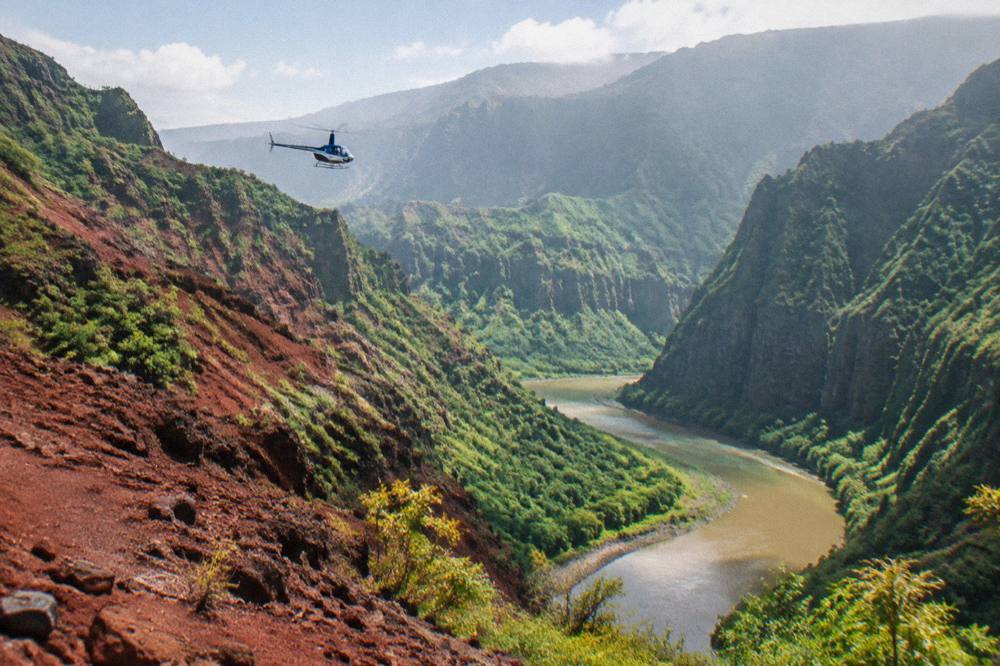
The standard full-island route covers the Na Pali Coast, Waimea Canyon, Manawaiopuna Falls from the air, the Waialeale crater area when weather permits, and the Hanalei Bay and Princeville coastline. Every flight on this roster flies a version of it, and the differences are duration, departure point and whether the aircraft lands. The one landing flight on this roster sets down on the rim of Olokele Canyon, not at Manawaiopuna Falls, which every other flight only flies past.
The geography is what makes the pictures. Waimea Canyon, about 14 miles long and up to 3,600 feet deep, photographs as layered red and green walls that change character with the sun angle. The Na Pali Coast, 16 miles from Polihale to Kee Beach, offers sea cliffs rising as much as 4,000 feet, and the flights track along them long enough for a full card. Manawaiopuna Falls, the 400-foot cascade on private land in Hanapepe Valley with no public trail, appears on the full-island routes as an aerial subject only, the listing for the Safari landing flight is explicit that its landing is at the canyon rim, and the falls landing itself belongs to an operator that has no card on this site, so this guide states only what that operator states.
The departure point changes the first ten minutes of shooting. Everything on this roster leaves from the Lihue area except the Discover flight from Princeville, a 45-minute Blue Hawaiian flight from Princeville Airport over Hanalei Bay and Na Pali in a cabin of up to four, from $579 per person with a 4.9 rating from 34 reviews. North-shore photographers save the transit to Lihue and open over Hanalei instead. The departure points guide maps every base, and the tour routes guide breaks down what each flight overflies.
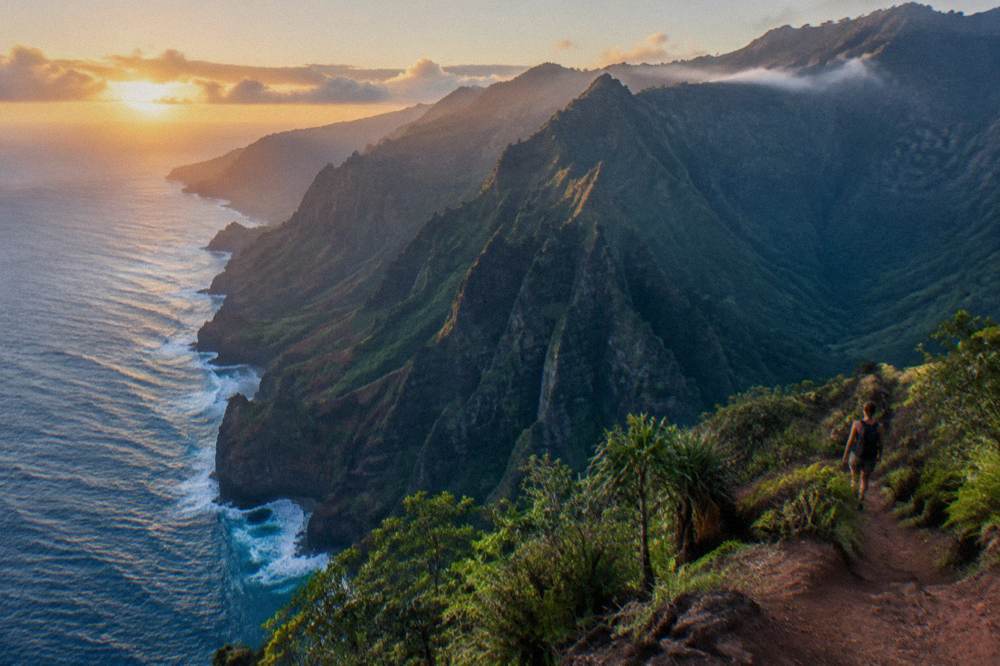
One honest note on the ground side: DLNR lands on Kauai, including Kokee State Park, Kokee Road, Waimea Canyon Drive, Haena and the Kalalau Trail, were closed after Hurricane Lowell, and access follows DLNR notices. Reports after the storm said Lihue helicopter tours were flying with fewer slots than usual, so read the live listing before planning a shoot day around a single flight. Flights see the canyon and coast from the air regardless, and no operator here promises a flight will run.
For a photographer, the private Ali'i doors-off flight is the most flexible platform on the roster: 1 hour 15 minutes, your group only, minimum two paying passengers, from $425 per person, 5.0 from 1,794 reviews. A guest review captures the experience: "Once in a lifetime experience! Breathtaking views. Will was an amazing tour guide and helped calm my father's nerves before taking off. Best excursion of our lives! Definite recommend."
When Is The Best Light For Kauai Aerial Photography?
Mornings generally offer the calmest winds and the most stable air, a pattern the operators themselves acknowledge, and summer months bring the clearest conditions over the coast and the interior. Lihue's rainfall normals back the summer case: the drier months run from June through August at under 2.4 inches each, while March averages 5.61 inches. Cloud over Waialeale can hide the crater on any given day, so photographers book the earliest slot the listing offers.
The climate record for Lihue, from the NOAA 1991-2020 normals, shows the monthly pattern plainly. January through March and November through December are the wet months, with March the wettest at 5.61 inches of rain on average. June, July and August are the driest, at 1.79, 1.75 and 2.33 inches respectively. The trade-off is light: winter's lower sun gives longer shadows across the canyon walls, while summer's high sun and clear air give the clean, saturated color most aerial photographers want.
The time-of-day question splits the sources slightly. Blue Hawaiian's own FAQ and Safari's FAQ state that time of day makes little difference to what you see, while local guides suggest a morning slot for the calmest winds, and the pattern holds year-round that mornings before midday bring the steadiest air over the cliffs. For photography the practical answer is both: morning light is softer and the air is smoother, and an early booking also leaves room in the day for a weather reschedule.
| Month | Average Rainfall At Lihue (Inches) | Average High (F) | Photography Notes |
|---|---|---|---|
| January | 2.78 | 78.6 | Low winter sun, long canyon shadows |
| March | 5.61 | 78.5 | Wettest month, highest cloud risk |
| June | 1.79 | 83.3 | Driest start to summer, clear coast |
| July | 1.75 | 84.6 | Clearest skies, harshest midday light |
| September | 2.18 | 85.3 | Warm, post-summer calm |
| December | 4.64 | 79.1 | Wet, but dramatic cloud work possible |
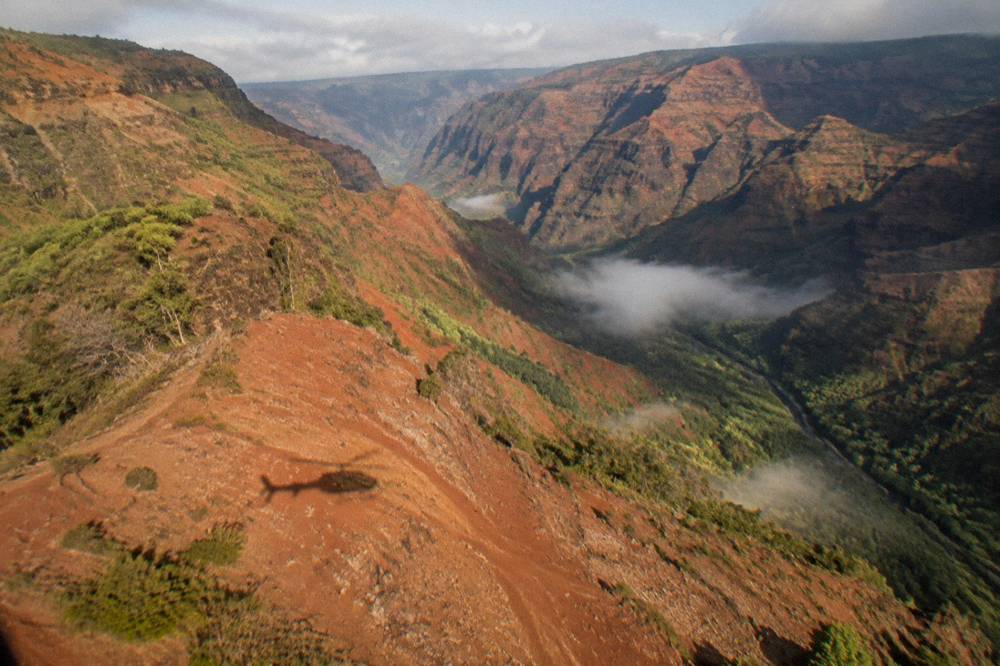
The best time of day guide works through the slot question in full, and the best time to visit guide covers the seasonal picture.
What Do The Photography-Friendly Flights Cost?
Photography-friendly helicopter tours range from $221 to $579 in price: doors-off shared flights cost $221 to $460 per person depending on duration, private doors-off flights run $384 to $425, and doors-on shared flights span $336 to $579. The cheapest open-frame ride is the 18-minute Heart of the Island doors-off flight at $221, while the 1 hour 15 minute Ali'i private doors-off flight is the longest at $425.
Price and format trade against each other in a predictable way. Short doors-off flights cost less and cover less ground. Long private flights cost more per minute but hand you the cabin. The doors-on shared flights sit in the middle and let you bring the most gear. The table below lists the flights a photographer is most likely to compare, with the roster's from-prices, which vary by date and group.
| Flight | Format | Duration | From Price Per Person | Rating And Reviews |
|---|---|---|---|---|
| Heart of the Island doors-off | Small group doors-off, up to 4 | 18 minutes | $221 | 4.8 from 16 reviews |
| Safari 55-minute waterfall safari | Shared doors-on, up to 6 | 55 minutes | $336, fees included | 4.8 from 963 reviews |
| Air Kauai Ohana doors-on | Shared doors-on, up to 6 | 45 minutes | $349 | 4.8 from 212 reviews |
| Mauna Loa private doors-off | Private, all window seats | 55 minutes | $384 | 4.8 from 522 reviews |
| Air Kauai doors-off | Shared doors-off, up to 6 | 50 minutes | $402 | 4.8 from 545 reviews |
| Ali'i private doors-off | Private, your group only | 1 hour 15 minutes | $425 | 5.0 from 1,794 reviews |
| Jack Harter MD500 doors-off | Small group doors-off, up to 4 | 60 minutes | $460 | 4.8 from 425 reviews |
| Blue Hawaiian 50-minute eco flight | Shared doors-on, up to 6 | 50 minutes | $489 | 4.8 from 2,065 reviews |
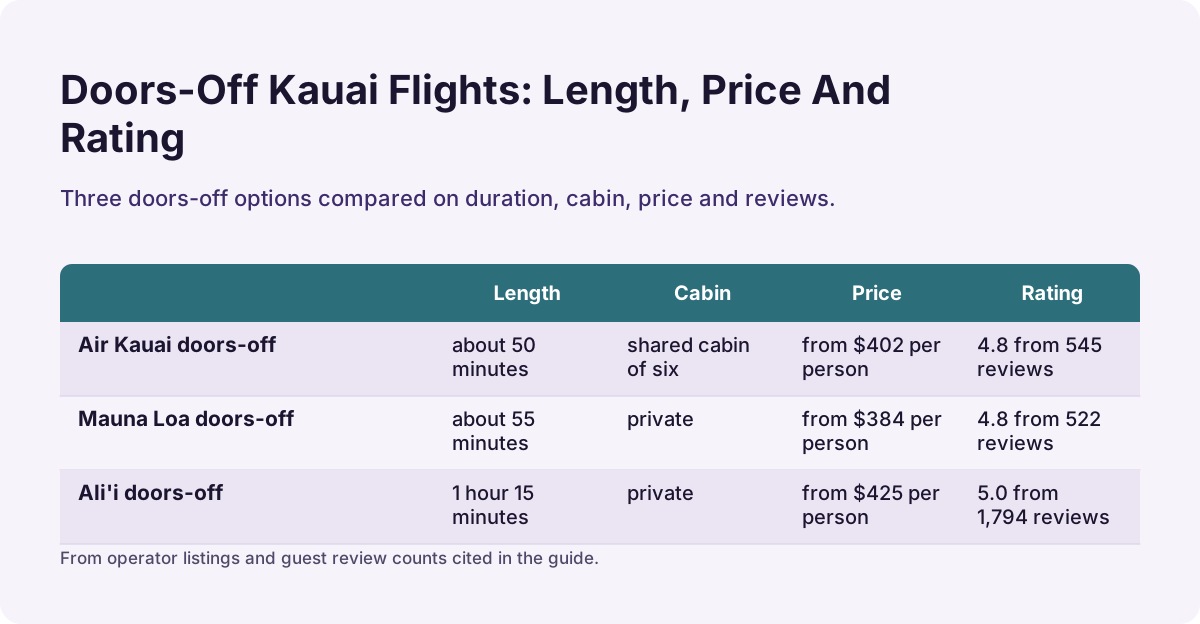
The full price picture, including what the fees and taxes situation is on each listing, is in the helicopter tour prices guide. The Safari, Air Kauai and Blue Hawaiian listings state fees and taxes are included in the price; on the others, read the listing for the final figure.
How Do You Prepare For A Photography Flight On Kauai?
To prepare for a photography flight on Kauai, wear dark, matte clothing to cut reflections on doors-on flights, arrive for weigh-in with everything you plan to carry, and read your listing's harness and age rules before you book. Doors-off passengers ride in a five-point harness anchored to the airframe, and age minimums are 10 on the Air Kauai and Jack Harter doors-off listings and 7 on the private doors-off listings.
The clothing point comes straight from the guest experience. The Safari review's advice, wearing darker clothing to reduce glare off arms and legs, applies to every doors-on flight on the roster. On doors-off flights the clothing question flips to warmth and security: nothing loose, layers for the wind, and the goggles the operator supplies rather than sunglasses that can lift off.
Preparation also means knowing the harness and age rules. The Air Kauai doors-off listing sets a minimum age of 10, and 16 for an outside or edge seat. Jack Harter's doors-off listings state 10. The private doors-off listings go lower: 7 on both the Ali'i flight, which also requires at least 40 pounds, and the Mauna Loa flight, where ages 7 to 11 sit next to a closed door. The flying with kids guide covers the family side, and the what to wear guide handles the clothing detail.
Finally, plan for the weather call. Trade winds and cloud over the coast and the interior cause cancellations and route restrictions, especially later in the day, and the operators' own terms handle it: the listings state free cancellation up to 24 hours before the start time, and weather cancellations are rescheduled or refunded per the operators. A photographer books the earliest slot, keeps the day flexible, and treats the flight as the first plan rather than the only one.
For photographers who want to test the open-frame format without the full-island price, the 18-minute Heart of the Island doors-off flight, from $221 per person with a 4.8 rating from 16 reviews, is the low-commitment entry, and its small review pool is worth knowing about when you read its rating.
The three formats one last time, side by side, before the questions:
Common Questions About Photographing Kauai From A Helicopter
Doors-off or doors-on, which is better for photos?
Doors-off gives cleaner frames because there is no glass, but the Air Kauai doors-off listing allows only a lanyarded phone. Doors-on flights let you bring a camera and telephoto gear, at the cost of glare and reflections, which guests report reducing with dark clothing.
Can I bring a real camera on a Kauai helicopter tour?
On doors-on flights, yes, the operators permit camera gear in the cabin. On the Air Kauai doors-off flight, no: the listing states only a lanyarded phone may come on board, and goggles are supplied. Read the specific listing before packing.
Can I choose my seat on a Kauai helicopter flight?
Not on shared flights. Seats are assigned by weight and balance, and passengers are weighed at check-in under the FAA performance-plan rules for Hawaii air tours. For a guaranteed window, the Mauna Loa private doors-off flight seats every passenger at a window, and the Ali'i private flight gives your group the whole cabin.
What is the cheapest doors-off flight for photography?
The Heart of the Island doors-off flight, 18 minutes into Waialeale with at most four passengers, runs from $221 per person. It carries a 4.8 rating from 16 reviews, a small pool worth reading before you book.
When is the best light for aerial photos of Kauai?
Mornings generally bring the calmest winds and the steadiest air, and the drier summer months, June through August averaging under 2.4 inches of rain at Lihue, offer the clearest conditions. Book the earliest slot your listing offers and keep the day flexible for weather.
Do any Kauai helicopter tours land so I can shoot on the ground?
One flight on this roster lands: the Safari 90-minute flight sets down on the rim of Olokele Canyon for a walk-around, from $396 per person. Its listing is explicit that the landing is at the canyon rim, not at Manawaiopuna Falls, which the other flights pass only in the air.