Best Time To Visit Kauai For Clear Helicopter Views
Kauai is one of the wettest islands in the world, and the difference between a crystal-clear flight and a clouded-out one often comes down to the month and the hour you pick. Here is how the island's weather actually behaves, and how to plan around it.
Short answer
Lihue's NOAA normals show the driest stretch runs June through August, with monthly rainfall between 1.75 and 2.33 inches and average highs in the mid 80s. March is the wettest month at 5.61 inches. For the clearest helicopter views, most sources point to summer and morning departures, and every roster flight can be cancelled or rerouted by weather with a refund or reschedule.
Kauai averages 36.22 inches of rain a year at the Lihue Airport gauge alone, and the island's interior summit, Waialeale, pulls down roughly 450 inches annually, one of the wettest spots on Earth. That single contrast explains most of what a visitor needs to know about timing: the coast can be bathed in sun while the crater your helicopter wants to see sits under cloud. The 50-minute shared eco flight from Lihue loops Waialeale, Hanalei Bay, the Na Pali Coast, Waimea Canyon and Manawaiopuna Falls, and every one of those five targets behaves differently through the year. This guide lays out the verified rainfall record for Lihue, the season patterns that matter for flights, and how the current DLNR closures after Hurricane Lowell change the planning picture. Once you've settled on the right weather window, the Kauai itinerary built around a helicopter flight shows how to fold that flight into a full island plan.
What Is The Best Time To Visit Kauai?
The driest and calmest window runs roughly May through September, with Lihue's June, July and August normals at 1.79, 1.75 and 2.33 inches of rain respectively, and summer reported as the season with the least cloud over the Na Pali Coast and interior valleys. March is the wettest month on the Lihue record at 5.61 inches. Within any month, morning departures are the commonly recommended slot, since trade winds and cloud build later in the day.
The honest version of this answer has two layers. The first is the climate record, which is solid: the National Centers for Environmental Information publish 1991 to 2020 normals for the Lihue Airport station, and they show a clear summer dip and a winter rise in rainfall. The second layer is operational reality. Kauai helicopter flights are weather-dependent by nature, and the trade winds that make the island green are the same winds that push cloud over the ridgelines a helicopter tour wants to see. No month guarantees a clear flight, and no operator promises one.
That is why the booking mechanics matter as much as the calendar. Every flight on this site's roster states free cancellation up to 24 hours before the start time, and the operators state that weather cancellations are rescheduled or refunded. A trip planned for the statistically driest week can still lose a flight to a passing front, and a trip in March can still get a perfect morning. The goal of timing is to raise the odds, not to promise the outcome.
For readers planning the wider trip, the best time to visit Kauai question also has a time-of-day answer, and the two decisions compound: a summer month plus a morning slot is the highest-probability combination the data supports.
How Does Kauai's Rainfall Actually Behave Month By Month?
Kauai's rain runs in a clear annual cycle: Lihue's NOAA 1991-2020 normals bottom out from June through August at 1.79, 1.75 and 2.33 inches, climb through fall to a December peak of 4.64 inches, and spike to 5.61 inches in March before dropping sharply to 2.03 inches in April. Average highs barely budge, from 78.6 in January to 85.3 in September, so rainfall, not temperature, drives the timing call.
The table below is the full monthly record from the Lihue Airport station. These are 30-year averages, not forecasts, and they describe the leeward side where the airport sits; the north shore and the mountain interior run wetter in every month.
| Month | Avg rainfall (in) | Avg high (F) | Avg low (F) |
|---|---|---|---|
| January | 2.78 | 78.6 | 66.0 |
| February | 3.63 | 78.1 | 66.2 |
| March | 5.61 | 78.5 | 67.3 |
| April | 2.03 | 79.8 | 69.5 |
| May | 2.18 | 81.6 | 70.9 |
| June | 1.79 | 83.3 | 73.4 |
| July | 1.75 | 84.6 | 74.6 |
| August | 2.33 | 85.2 | 75.2 |
| September | 2.18 | 85.3 | 74.8 |
| October | 3.27 | 83.9 | 73.6 |
| November | 4.03 | 81.2 | 71.3 |
| December | 4.64 | 79.1 | 68.6 |
Two readings of that table matter for a flight. The first is the March spike: at 5.61 inches, March carries more than three times July's rainfall, and it lands right in the spring-break travel window. The second is the shoulder structure. April, May and September sit at roughly 2 inches each, which makes them genuine value windows: drier than the winter months, cooler and quieter than August.
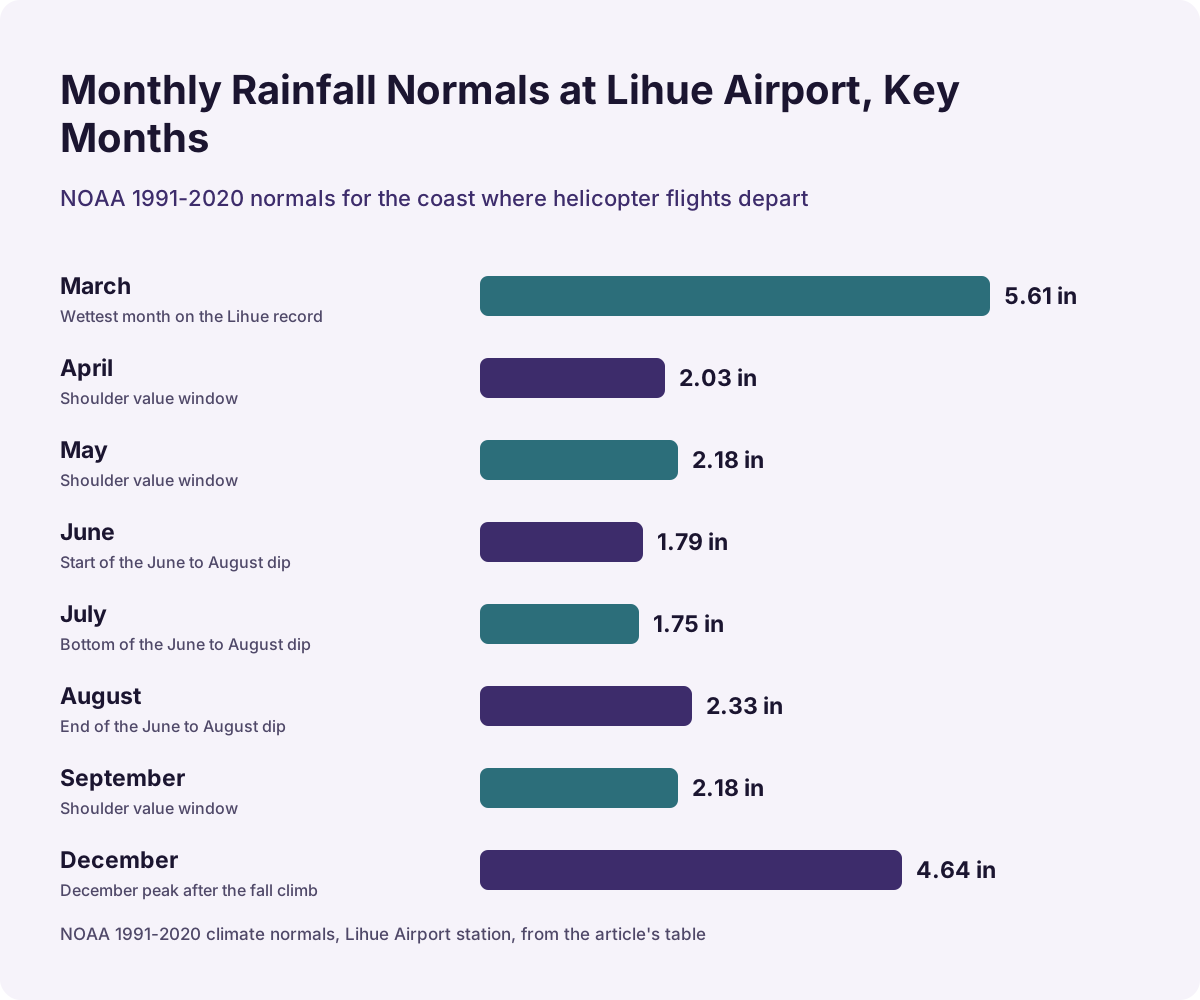
One caution on interpretation. These numbers measure the coast. Waialeale's roughly 450 inches a year fall a few miles inland and several thousand feet up, and the crater that anchors most full-island routes lives in that wet zone. A dry month in Lihue raises the odds the crater is open; it does not make the odds certain.
The practical takeaway from the rainfall record is not to avoid winter outright. It is to build slack into a winter trip: book the flight early in the stay, keep a backup morning free, and treat the 24-hour free cancellation window as the safety valve it is. The full price and cancellation comparison shows how each listing handles a weather call.
With the climate record in hand, the next question is which flights to actually shortlist for that window.
All three of those are doors-on shared flights out of the Lihue area, which is the format most first-time visitors choose, and all three state free cancellation up to 24 hours before the start time. That cancellation term is the single most important weather-hedging feature on any Kauai listing.
Which Months Give The Clearest Helicopter Views?
Summer, roughly May through September, is the window most sources identify for reliable conditions, with clearer skies and less cloud over the Na Pali Coast and the interior valleys than the November to March stretch. Within any given day, mornings before about 10 am are reported to offer the calmest winds. Trade winds and cloud frequently force cancellations or route changes after late morning, whatever the month.
The seasonal pattern comes down to wind and moisture working together. In summer the trade winds tend to blow steadily and the air mass is drier, so the characteristic puffy clouds stay small and scattered. In winter the same winds pick up more moisture and the clouds stack against the mountains, which is why a winter flight can circle a wall of white exactly where the crater should be. The trade-off is that winter rain is what fills the falls: a flight after wet weeks sees waterfalls running hard, and the roster's flights all pass Manawaiopuna Falls, the 400-foot cascade on private land in Hanapepe Valley with no public trail, so the air is the only way to see it.
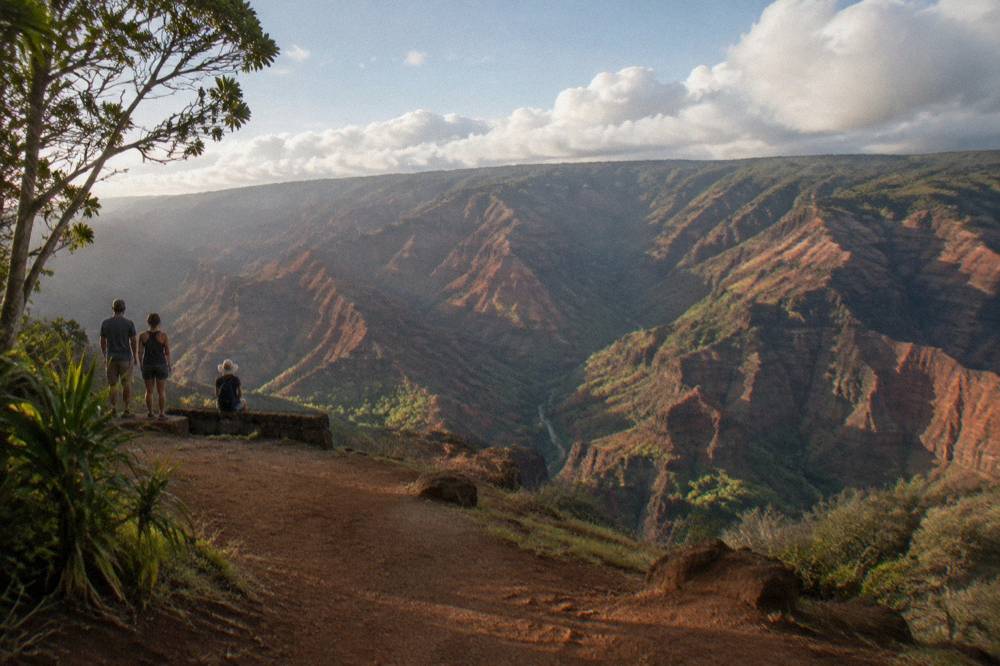
A hedged way to use the seasons is to match the flight to the month. The table below pairs each season with what the sources actually say, without promising anything.
| Season | Rain pattern at Lihue | Reported flight conditions | Planning note |
|---|---|---|---|
| Summer (May to Sep) | 1.75 to 2.33 in per month | Reported driest and calmest, clearest over Na Pali and interior | Book any time of day with confidence, mornings still preferred |
| Fall (Oct to Nov) | 3.27 to 4.03 in | Transition, building cloud risk | Early flights, flexible backup morning |
| Winter (Dec to Feb) | 2.78 to 4.64 in | More cloud, higher cancellation and reroute risk | Falls run hardest after wet weeks, build slack into the stay |
| Spring (Mar to May) | 5.61 in in March, then 2.03 to 2.18 in | March is the wettest month on record, April and May recover | Avoid mid-March if the flight is the trip's centerpiece |
One review on the eco flight's listing captures why the odds still favor going: "Must do experience, such a diverse island that can really only be appreciated by air. Smooth flight, great narration by our pilot Alex as we traversed the island. Definitely the highlight of our Hawaiian holiday." (Ann B., 5 stars, verbatim traveler review). That guest flew in conditions good enough to see the island whole, which is the outcome timing is aimed at.
If the calendar is fixed and the month is wet, the doors-on shared flights are the resilient choice, since a cabin with doors flies comfortably through light showers that a doors-off flight would rather sit out. Readers weighing that trade can compare the doors-off format in detail.
What About Winter: Surf, Rain And Cloud On The North Shore?
Winter on Kauai means two separate weather stories. At Lihue, December through February averages 2.78 to 4.64 inches of rain a month. On the North Shore, winter surf runs about 6 to 15 feet or more from roughly October to April, against 1 to 3 feet in summer. For flights, winter raises cloud risk over Hanalei Bay and the Na Pali Coast, but the same rain keeps the island's waterfalls at full flow.
The surf number matters less to a helicopter than to a beach day, but it shapes the coast's look. A winter flight over Hanalei Bay sees big breakers on the reef; a summer flight sees glass. Neither is better, they are different photographs, and the photography guide covers how to shoot both from a moving cabin.
The cloud story is the real winter cost. The north shore sits windward, so it takes the moisture first. A flight can be clear over Waimea Canyon on the dry west side and shut out over Hanalei ten minutes later. Pilots reroute around weather rather than cancel when they can, which means a winter flight may see the canyon and the coast but skip the crater. The listing for the 50-minute eco flight names Waialeale as a route target, and the standard full-island routes from Lihue cover Na Pali, Waimea Canyon, Manawaiopuna Falls, the Waialeale crater weather permitting, and the Hanalei Bay area, so a weather-driven skip is a real possibility in any month.
Winter also carries the island's flood episodes. The Kuhio Highway near Hanalei Bridge saw flood closures in late September and early October 2026, a reminder that north-shore access and conditions can change inside a single week. None of that stops a flight from Lihue, but it can change what the ground half of a trip looks like.
How Do The Hurricane Lowell Closures Change The Timing Picture?
A DLNR notice of 16 September 2026 closed all DLNR lands on Kauai, including Kokee State Park, Kokee Road, Waimea Canyon Drive and Haena, and the notice said clearing could take many more weeks. Reports after the storm said Lihue helicopter tours were flying with fewer slots than usual. Access to the state parks follows DLNR notices, and no reopening date is given, so a trip plan should not assume ground access to the canyon or the Kalalau Trail.
This is the part of the timing question that changed most recently. Before the storm, a common Kauai plan paired a helicopter flight with a drive up Waimea Canyon Drive to the lookouts at mile markers 10, 13.5, 18 and 19. The DLNR notice closed that road with fallen trees in multiple sections, and a 24-hour roadblock went up at the Kokee Road junction. The DLNR's own notices are the authoritative source for access, and any plan that assumes the road, the park or the Kalalau Trail is open should be checked against them close to travel.
Flights are a separate matter. Reports after the storm said tours from Lihue were operating, with fewer slots than usual, and the canyon and coast remain visible from the air regardless of what the roads are doing. That is not the same as saying a flight is the only way to see the canyon, and this site does not claim that; it is saying that the air side of the view does not depend on the road status, while the ground side does. The wider set of guides lives on Helicopter Tours Kauai.
For timing, the practical effect is a shift in how a trip's days stack up. With ground access to the canyon and Haena following DLNR notices, the flight can carry more of the sightseeing load than it would in a normal year. Booking it early in the stay, with a spare morning behind it, matters more now than in a year when the drive-up lookouts are a fallback.
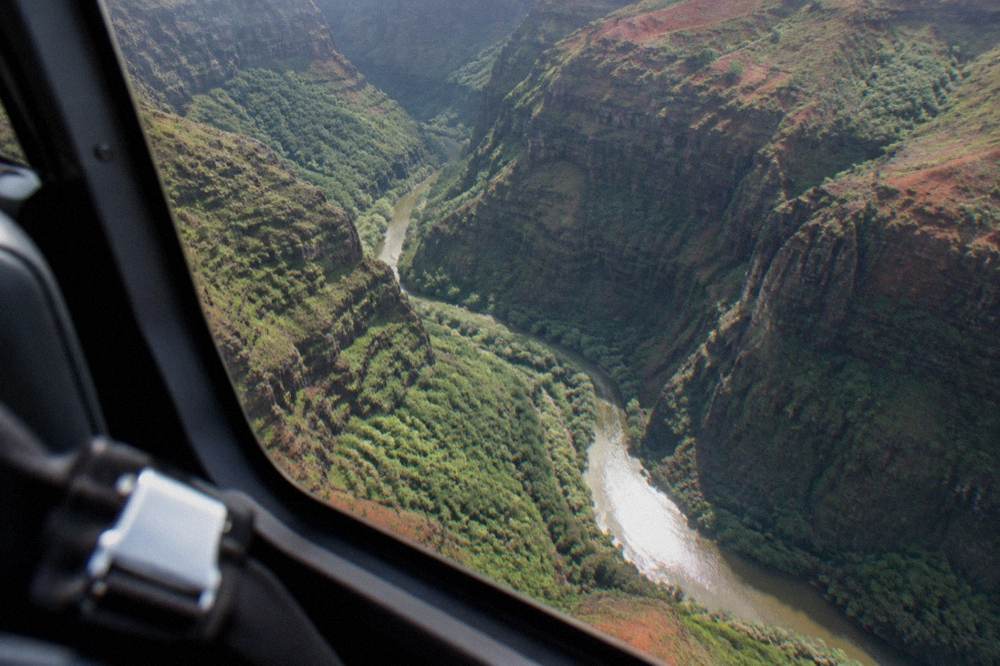
Which Flights Fit Which Season And Schedule?
The roster's shared doors-on flights run 45 to 55 minutes from roughly $336 to $579 per person, the doors-off shared flights run 18 to 60 minutes from $221 to $460, and the two private doors-off flights run 55 minutes to 1 hour 15 minutes from $384 to $425 per person. Short flights suit tight windows, long flights suit a once-only trip, and the landing flight adds a canyon-rim walk to the air time.
The table below lays out the roster by format so the timing decision and the format decision can be made together.
| Flight | Format | Duration | From (per person) | Departure |
|---|---|---|---|---|
| Blue Hawaiian 50-Minute Flight | Shared doors-on, up to 6 | 50 min | $489 | Lihue Airport, Blue Hawaiian heliport |
| Safari 55-Minute, Fees Included | Shared doors-on, up to 6 | 55 min | $336 | Safari office, Akahi St, Lihue |
| Doors-On Family Flight | Shared doors-on, up to 6 | 45 min | $349 | Lihue Airport heliport |
| Princeville Departure, 45 Minutes | Shared doors-on, up to 4 | 45 min | $579 | Princeville Airport |
| Doors-Off, 50-Minute Flight | Shared doors-off, up to 6 | 50 min | $402 | Lihue Airport heliport |
| MD500 Doors-Off, 60 Minutes | Small group doors-off, up to 4 | 60 min | $460 | Jack Harter office, Lihue |
| Doors-Off, 18-Minute Flight | Small group doors-off, up to 4 | 18 min | $221 | Jack Harter office, Lihue |
| Private Doors-Off Flight | Private, your group only | 1 hr 15 min | $425 | Lihue Airport Commuter Terminal |
| Private Doors-Off, All Window Seats | Private, your group only | 55 min | $384 | Mauna Loa heliport, Ahukini Rd |
| Canyon Rim Landing, 90 Minutes | Shared doors-on with landing | 1 hr 30 min | $396 | Safari office, Akahi St, Lihue |
Season interacts with format in two ways worth planning on. First, doors-off flights are more exposed to weather calls: an open cabin in a passing shower is a different experience, so a winter booking in that format deserves an extra backup morning. Second, the longer the flight, the more weather it has to thread. The 90-minute Canyon Rim Landing flight covers the most ground and lands for a walk-around on the rim of Olokele Canyon, which is the most schedule-sensitive product on the roster; a summer morning is the natural slot for it.
The landing itself is worth being precise about. The listing is explicit that the touchdown is on the Olokele Canyon rim, not at Jurassic Falls and not at Manawaiopuna Falls, which sits on private land with no public trail and is only flown past. A review from a guest on the landing flight describes the walk-around as the difference-maker: "We just loved the tour. We try to book a helicopter tour whenever we travel to Kauai and I think this was the best. We saw all the sights and waterfalls that you can imagine, but landing in the canyon and walking around was a bonus." (Karl R., 5 stars, verbatim traveler review).
For travelers staying on the north shore, the Princeville departure changes the timing math entirely: it is the only non-Lihue departure on the roster, a 45-minute flight from Princeville Airport over Hanalei Bay and the Na Pali Coast in a cabin of up to four, and it removes the drive to Lihue from the morning plan.
Should You Time Your Trip Around Crowds And Costs?
Kauai recorded 1,407,632 air arrivals in 2025, up 1.0 percent, with visitor spending of $2.94 billion and 73.2 percent of visitors being repeat travelers, per the state's annual visitor report. No verified monthly arrival figures exist for the island, so crowd timing rests on general season logic: summer and mid-winter run busiest, and the April to June and August to October shoulders are noted for pleasant weather and lower rates.
The repeat-visitor figure is the quiet insight in that data. Nearly three quarters of Kauai's visitors in 2025 had been before, which means the island's demand is less tied to first-time bucket-list surges and more to a loyal returning base. For a first-time visitor timing a flight, that cuts both ways: the returning crowd books early and knows which slots to take, so the well-reviewed morning slots in high season can fill well ahead.
Cost timing is harder to pin down with verified numbers, and this site does not print aggregator price ranges. What the roster shows is a from-price spread of $221 to $579 per person across formats, with the biggest single driver being duration and privacy rather than season. A shoulder-season trip does not make the flight cheaper in any documented way; it makes the whole trip, rooms and cars and everything around the flight, less contested. The DBEDT annual visitor report is the primary source for the arrival and spending figures.

What Time Of Day Should You Book The Flight?
Morning departures, before about 10 am, are the commonly recommended slot, with reports of the calmest winds early in the day. The operators themselves say time of day makes little difference to their schedules, while a local hotel guide suggests a morning slot, so the honest summary is that mornings are the consensus hedge, not a rule. Trade winds and cloud frequently cause cancellations or route restrictions after late morning, which is the case for going early.
The reason mornings win is mechanical. Trade winds build through the day, and orographic cloud, the kind that forms when air is pushed up over the mountains, thickens with them. By early afternoon the summits that anchor the route are often capped. A 9 am departure flies before that process has run, which is why the same flight can be clear at dawn and clouded at 2 pm on an otherwise identical day.
There is a second, less obvious argument: the backup-slot logic. If a morning flight cancels for weather, an afternoon slot the same day gives the operator a same-day retry option, and a flight booked on day one or two of a stay leaves the rest of the trip as retry space. Booking the last morning of a ten-day trip removes every fallback. The time-of-day comparison works through this in detail, and the itinerary guide places the flight inside a full trip plan.
The 60-minute doors-off MD500 flight illustrates why the slot matters more as the flight gets longer: an hour of air time threading canyons and coast gives weather more room to interfere than an 18-minute hop does. A review from that flight describes the payoff when the timing works: "Arthur was our pilot and he narrated the whole ride very well. We went in and out of canyons, gorges, seashores and mountains. What a breath taking view! This ride was the best activity I've done. You can see the whole island in an hour. I was just in awe!" (Samina T., 5 stars, verbatim traveler review).
One FAA rule is worth knowing alongside the timing advice, because it explains why flights route the way they do. Under 14 CFR 136.75(d), no Hawaii air tour may fly below 1,500 feet above the surface except for takeoff, landing, an ATC clearance or Administrator authorization, per the regulation text on the eCFR. The same section requires flotation gear beyond the shore and a performance plan before each flight, which is part of why check-ins include a weigh-in.

Common Questions About The Best Time To Visit Kauai
What Is The Best Time To Visit Kauai?
May through September is the window the sources identify, with Lihue's summer rainfall normals at 1.75 to 2.33 inches per month and the clearest reported conditions over the Na Pali Coast and interior valleys. April and May, and September, are strong shoulder picks at about 2 inches each. March is the wettest month on the Lihue record at 5.61 inches.
What Is The Rainy Season On Kauai?
October through March carries the higher rainfall months on the Lihue normals, with December at 4.64 inches and March at 5.61 inches. Summer, June through August, is the driest stretch at 1.75 to 2.33 inches per month. The island's interior is far wetter than the coast in every season.
What Time Of Day Is Best For A Kauai Helicopter Tour?
Mornings before about 10 am are the commonly recommended slot, with reports of the calmest winds early in the day. Trade winds and cloud frequently cause cancellations or route restrictions after late morning. The operators say time of day makes little difference to their schedules, so mornings are a hedge, not a rule.
Are Helicopter Tours On Kauai Flying After Hurricane Lowell?
Reports after the storm said Lihue helicopter tours were flying with fewer slots than usual. Access to DLNR lands, including Waimea Canyon Drive, Kokee and Haena, follows DLNR notices, and no reopening date is given. Read the live listing for the flight you want before travel.
Do Kauai Helicopter Tours Get Cancelled For Weather?
Yes, and every listing on this site's roster states free cancellation up to 24 hours before the start time, with weather cancellations rescheduled or refunded per the operators. Booking early in a stay, with a backup morning free, is the standard way to absorb a weather call.
Is Winter A Bad Time To Fly Over Kauai?
Winter raises the cloud risk, but it also fills the waterfalls, and every roster flight passes Manawaiopuna Falls. A winter flight after wet weeks can see the falls at full flow. The trade-off is a higher chance of a reroute or cancellation, so build slack into the trip.